Tuesday, 23 January 2018

The Ernest Willows Pub - and the man behind the name.

The Pub

City Road Cardiff


A Wetherspoons pub never is never small and cosy with a real fire burning in the corner.  Many are in large old buildings of notable architecture. I wouldn't describe the Ernest Willows  in City Road, Cardiff as being of notable architecture.  Art deco would even be stretching it.  The building apparently used to be a garage and also a bicycle shop.  It is however friendly, spacious and has an outside area with its own mini-Gorsedd Circle feature around the side.  


What the pub lacks in charm is more than made up for by its fabulous award-winning toilets.  Before you men get too excited, I'm mainly here talking about the ladies toilets, not that I've seen them firsthand of course. 

The ladies toilets in Ernest Willows.  Wish I could go in here!

The opulent ladies toilets are full of marble and mosaic tiles with a central feature that wouldn't be out of place in the middle of an Italian town. I'm not sure of the history of the ladies toilets but I imagine the builder was told 'If you do a good job for us here then we've a 1000 more for you to have a go at'.

Our visit.

We did a bit of exploring of the area by first visiting Roath Farmers Market and lunching on the tasty vegetarian bibimbap and beef bulgogi from Seoul Food Wales .   That meant arriving in the Ernest Willows on a cold day we were just in need of a coffee to warm ourselves up but then it was quickly on to sampling the real ale.  The pub serves a range of real ales, some originating from Wales.  I went for a tasty pint of Jemima's Pitchfork brewed by Glamorgan Brewing Co. The beer is named after the Welsh heroine Jemima Nicholas. At the 1797 Battle of Fishguard she rounded up and captured 12 drunk French soldiers, armed only with a pitch fork. 

A nicely poured pint of Jemima's Pitchfork

The walls of the pub are lined with pictures of famous Cardiffians, including of course our hero after which this pub is named. Ernest Willows was a pioneering airship designer born in 1886. His well-researched biography by Alec McKinty is entitled 'The Father of British Airships'. 

This would have been an apt beer to choose if it had been on.

Ernest Willows - the aviator

Ernest Willows constructed a number of airships, the naming of which probably didn't take up too much of his time.  Willows 1, powered by a motorbike engine, was constructed in his workshop in East Moors Cardiff in 1905 when he was just 19 years old.

Willows I in 1905
(IPC Transport Press)

In 1910, in Willows 2, he succeeded in flying it to the city centre and landing near the City Hall netting him a £50 prize for the first aerial voyage in Wales.   Buoyed by his success and now with a bit of publicity behind him, he did the same three days later, this time in front of a crowd of 40,000. 

Willows II landing outside Cardiff City Hall
(from Alec McKinty - the Father of British Airships)

 A new local hero was born.  Ernest advanced airship design in that he made his steerable, something that is no doubt a great advantage if you are trying to get somewhere in particular.

His next notable achievement was to fly from Cardiff to London in Willows 3 and become the first person to fly an airship over the Bristol Channel, something he could hardly avoid doing as it was on the way.


Channel hopping became all the rage and in November 1910 he was the first person to fly an airship from London to Paris and the first to fly an airship over the English Channel at night (and no I don't know who the first person to do it in daylight was but it probably made for a better spectator sport).  The flight wasn't without mishap and he had to put down soon after reaching France for repairs.

French magazine depiction of Willows landing in France - being charged customs duty for the gas he is carrying.


You would have thought by now that fame and financial success would no doubt follow but I'm afraid not.  A number of things happened which stopped this, most notably the outbreak of WWI and the invention of the aeroplane.   Ernest did however play a role designing the tethered barrage balloons which  prevented enemy planes getting too low over London to seek out their targets. He spent much of WWI managing the building of barrage balloons in Westgate Street, Cardiff.


The technical achievements of Ernest Willows and his airships  are well covered in McKinty's biography and also in a number of other blogs such as Then and Now. and Phil Carradice.  What interests me maybe more is his family history. 


Ernest Willows - Family History


Ernest Willows was born in July 1886 just around the corner from the pub at No.11 Newport Road in a row of houses known as Brighton Terrace that became part of the University.  His father, Joseph Willows, was a dentist who originated from Hull and his mother Evaline Willows, nee Garrett, was born in Bath.  By the age of four Ernest and the family had moved to Queen Street in Cardiff.  Young Ernest started school in Richmond Road and may even have gone to Cardiff High for a short period of time but most of his education was in Clifton College, Bristol where he lived with an aunt.  He was all set to follow his father's career and started training to be a dentist but evidently didn't take to it and soon working on airships became his passion, one his parents it seems fully supported. 

The young E T Willows
(South Wales Echo)
In 1908 Ernest marries sixteen year old Irene Davies from Haverfordwest in Lambeth, London.  Their first two children Evelyn and Clifford are born back in Cardiff.  Evelyn dies on the eve of her first birthday in Deri Road, Penylan, Cardiff in 1910.  Poor Clifford was to die in 1932 aged 22 in a motorcycle accident on his way to work as a draughtsman in Whitley aerodrome, Coventry.  They have two more children; Dorothy who was born in West Bromwich in 1912 and died in 1980 and Ernest Joseph Denman Willows born in Hendon, London in 1914 and died in 1989, neither of whom married, so unfortunately it appears there are no living decedents of our hero Ernest Willows.  Ernest did have two sisters, Daisy who died in infancy and Doris.  It is from this line where it gets interesting from a local history point of view where one of Doris's daughters marries into the Crouch family, the famous Cardiff jewellers.

Ernest Willows in 1911

Anyway, I digress.  What of Ernest himself I hear you ask.  Unfortunately he doesn't have a lot of luck either.  He never seems to make a lot of money from his airship business.  In 1921 he loses all his worldly belongings overboard from a ship in off the Isle of Wight and ends up living with his family in a schooner moored up in Chiswick on the Thames.  His post-war career appears to be based on giving people joy rides in balloons. One night in 1925, his balloon escapes from its mooring in the Wembley Exhibition and crashes into the house of Sir Hector Rason, a former Premier of Western Australia, wrecking the porch, knocking off the chimney pots and filling the house with hydrogen gas.

Ernest takes off on his journey from Cardiff to London
(Flight magazine)

Ernest Willows life is cut short at the age of just 40 when he died in a ballooning accident in Bedford when taking two others for a ride in the balloon.  The basket gets detached from the balloon and plummets to the ground.  He is buried in Cathays cemetery in Cardiff along with his parents and infant child Evelyn.

  
Willows family headstone in Cathays cemetery

Saturday, 6 January 2018

Cardiff University Queen's Buildings


Cardiff University Engineering Department  isn't where I was expecting to see a skeleton. There I was relaxing on the upper deck of the bus when I spotted it out of the window.  It's on the stone facade above the doors and looking very Gothic indeed.  The rest of the stone facade looked interesting too, comprising of two statues and four relief stone carvings of distinguished scientists.              

Engineering Department skeleton
Why the skeleton?
I did a bit of research, didn't find a great deal, so went back and took some photos on a dank December morning.  An ideal topic for a blog post I thought.  Four sculptured busts of scientists, Jenner, Lister, Hunter and Pasteur.  I could write a bit about each.  Then I did some more painstaking research and found a couple of blog posts.  One from Bob Speel looked at the sculptures in terms of the sculptor and style, the other from Pat English does pretty much what I going to do and looks at the scientists themselves.  Both blog sites are very good and I would recommend them.  I've little doubt that I can't hope to add much to their blog posts in terms of knowledge.

Relief Sculpture Cardiff University
Our four eminent scientists

I took the train up to Taffs Well a few months ago to take pictures and research the old viaduct only again to find someone had already posted an excellent blog on it. In that instance I abandoned my plans to write about it. Here however I think I will continue, if only to give myself some blogging practice. I purposely haven't read what Pat's post says about the actual scientists so as not to influence me.

Cardiff University Engineering Department
Cardiff University Queen's Building

The building in question is Cardiff University Queen's buildings on Newport Road. Much of the building is of modern construction but the old tower dates back to 1915. To give it it's proper description it is gothic Revival tower-facade retaining high-quality sculpture and I'm glad to see a listed building. There are two plaques on either side of the oak doors that indicate the first stone was laid in 1915 and then the building opened in 1921 by the then Prince of Wales. I say oak doors but that's a guess but they are decorated with what appears acorns, so hardly likely to be eucalyptus.


So if it's the engineering building, then why is it adorned with the statues and sculptures of four non-engineering scientists. Apparently the building was originally the Medical school which makes sense as it is close to the Royal Infirmary up the road. That would also explain the two life sized statues which are part of the Bath stone facade; Asclepius, Greek god of Medicine and I'd swear an oath the other one is Hippocrates . Asclepius is holding his staff and two cocks stand at his feet. It was traditional to sacrifice a cock to thank Asclepius for being healed. I would happily sacrifice a chicken or good piece of tofu if only I could get an appointment with my doctor.

Greek Gods Cardiff University
Asclepius and Hippocrates

There's so much on this facade to help keep you or your kids entertained if you are ever passing by on a bus or waiting at the bus stop. Get them to see how many carved animals that can spot just above the doorway. Among them I spotted a squirrel, lizard and mouse. And there's probably a live pigeon hiding away in there too.

Bird Mouse Lizard Cardiff
Carved animals on the Queen's Building

John Hunter


And so the scientists. Perhaps the least known is the 18th century Scottish surgeon John Hunter.  Now here's and interesting character.   

Surgeon Hunter
John Hunter

Throughout his career he collected many thousands animal and human corpses. It is said that his collection of live animals from around the world at his home in London may have led to the inspiration for the story of Doctor Dolittle. On the other hand his brother who obtained many of the human corpses for him has been accused of grave robbing and even worse calling into question whether Hunter was more like Dr Jekyll than Doctor Dolittle. To the top right of Hunter is a patient in a bed being watched over closely by a young man and a skeleton. Presumably this is to represent Hunter pioneering the importance of observations in medicine. But why the skeleton? I still don't know.

Dr Dolittle or Dr Jekyll - but which one was he?

Louis Pasteur.


Representing France is Louis Pasteur. People no doubt know Pasteur mainly for his work as a microbiologist but he started his career as a chemist and even obtained his first professorship in that field in the University of Strasbourg. His list of achievements are pretty staggering; vaccines for rabies and anthrax, inventing pasteurisation and an understanding of fermentation. After he died in 1895 he was buried in the Cathedral of Notre Dame, but his remains were reinterred in the Pasteur Institute in Paris. I'm not convinced that's a move for the better if you ask me. Would I want to be taken back to work after I die? Before passing he asked for his laboratory notebook to be kept in the family and not shared. Only recently have historians gained access to them and are divided in what is revealed but seem to agree on the fact that a good summary would be "In spite of his genius, Pasteur had some faults". If I had an epitaph like that I'd be pretty happy.

Louis Pasteur Paris
Pasteur working away in his laboratory

Joseph Lister 


Joseph Lister was born in Upton House, West Ham, London. I bet I can guess which football team he supported. He's the man who realised that washing your hands, as every child knows, is so important. As the 'father of disinfection' he hailed the use of carbolic acid to sterilise everything in sight. Initially Lister's ideas were mocked by others in the health field who proudly wore their blood stained aprons as a badge of honour. The medical journal The Lancet warned the entire medical profession against his progressive ideas. Next time I smell the phenolic odour of Laphroig whiskey I will think of Joseph Lister and drink to him as a testament to his ingenuity.

Lister West Ham
Joseph Lister and his impressive sideburns

Edward Jenner


I suppose it's a sign of the times that when you put Jenner into a popular search engine everything that turns up is about Caitlyn Jenner, who is apparently an American sex-reassigned ex-athlete and now TV personality. A couple of pages down you come across our man, Edward Jenner, from the town of Berkeley, Gloucestershire. His work on the smallpox vaccine has led to the much used quote that he 'saved more lives than any other human' and earned him the title 'the father of immunology'.

Smallpox Jenner
Edward Jenner


The Unanswered Questions


And so we have it, what is probably a unique collection of sculptures of these four heroic scientists, Jenner, Pasteur, Lister and hunter all in the same place.  Other than the outstanding question of the skeleton I have one other query.  Why is it called the Queen's Buildings?

After I initially posted this blog post I had some input from a friend.  His thoughts on the John Hunter skeleton are:


Hunter acquired the skeleton of the 2.31 m (7' 7") Irish giant Charles Byrne against Byrne's clear deathbed wishes—he had asked to be buried at sea. Charles Byrne is a principal character in - Hilary Mantel's 1998 novel, The Giant, O'Brien.

However the skeleton may just be a reference to how he was involved in the examination of the dead. This could be insinuated in the eyeless stare of the skull which signposts the man on the slab as a cadaver.


Tuesday, 26 December 2017

A winding way to Cardiff Bay

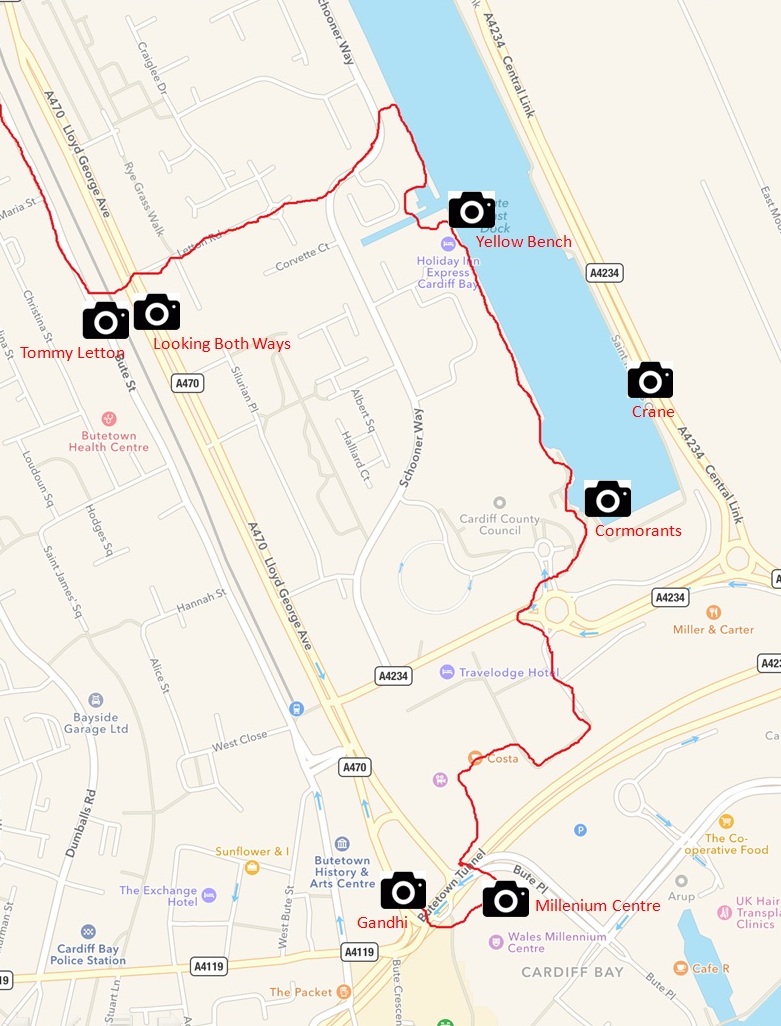
Its probably less than a mile from the centre of Cardiff to Cardiff Bay, particularly if you count the centre as being the Cardiff Central train station or John Lewis. There are quite a few different routes you can take though walking on the wide pavement alongside Lloyd George Avenue is probably the most pleasant.  I took in a bit of that route today but also deviated off to see some other interesting sights.  Here's what I saw.

First up was a blue plaque to Tommy Letton. Who was he?

Tiger Bay Cardiff Blue Plaque


Tommy 'the fish' Letton turns out to be a fishmonger who used to pull his cart through the streets of Tiger Bay in former years.  He's even got a road named after him.  This blue plaque is on the underpass that leads from Bute Street to Letton Street.

Letton Fish Cart
Tommy Letton and his cart in the 1960s. 

On the other side of the underpass I came out on Lloyd George Avenue, a wide boulevard that's not too busy and with a wide pavement and cycle path.  It make a good way to walk down to the Bay.

I came across Looking Both Ways, a sculpture by English sculptor David Kemp based in Cornwall.  It seems to have stood the test of time.

Lloyd George Avenue Cardiff
Looking Both Ways, in place since 2001 and still looking good.

David Kemp alongside one of his other works in 2010

It is possible to continue walking down Lloyd George Avenue from here towards Cardiff Bay but instead I wanted to take a look at Bute East Dock so headed east along Letton Road, over the old canal feeder, and down onto Schooner Way. After a bit of a scramble I managed to get down onto the block paved path that runs around the dock.

The East Bute Dock looking back up towards the city

Bute East Dock opened in 1859 and marked when Cardiff turned from an iron exporting town to a giant coal exporting city.


Andrew Rowe Bench
The Yellow Bench
The Yellow Bench, designed and built by Andrew Rowe in 1999, is outside the Holiday Inn Express. Andrew is a South Wales blacksmith based around Carmarthen.

Andrew Rowe who sculpted the Yellow Bench, making poppies in 2016 to be part of the new Cenotaph in Ypres, Belgium. 
Looking across Bute East Dock you can see a preserved dockside crane. It is a lot younger than the dock itself and a plaque describes how this 15 tonne electric crane has been moved around various dockside locations in Cardiff including the Queen Alexander dock.

Built in 1933 and decommissioned in 1983

Cormorants enjoying the sun in Bute Dock


I arrived at the southern end of Bute Dock but found that from there its rather a tortuous route through to Cardiff Bay. The path takes you up into the car park of Cardiff Council buildings when suddenly all footpaths seem to dry up. I ended up crossing Hemingway Road and found myself in the car park of the Red Dragon Centre. Failing to find a way around that I entered the centre itself then out the side entrance and over the road to the Millennium Centre.

I was about to critisise the architect of the Red Dragon Centre but thinking about it I wonder if it ever had an architect. It looks like the builders turned up, couldn't find the plans so built an ugly box,  thinking that they would return later to add the outside once the plans had been found. It's main entrance faces an ugly car park, not the lovely Millennium Centre. And whilst I'm at it I may as well moan about the walk between the Red Dragon Centre and the Millennium Centre. The way is blocked by curvy bollard type things. What's all that about?

Millennium Centre Cardiff Bay
Torchwood HQ in Cardiff Bay outside the Millennium Centre


Mahatma Gandhi sculpture


From here I headed over to take a look at the new Mahatma Gandhi sculpture that is outside Craft in the Bay. It was unveiled in October this year on the International Day of Non-Violence. The sculpture appears to have been paid for by fundraising by the Hindu Council of Wales. I rather like it I must say. I think its a welcome addition to the sculptures of the Bay area.


Mahatma Gandhi statue Cardiff Bay
The inscription reads "Non-violence is the greatest force at the disposal of mankind. It is mightier than the mightiest weapon of destruction devised by the ingenuity of man"

The unveiling took place on what would have been Gandhi’s birthday and was attended by the iconic statesman’s great-grandson, Satishkumar Dhupelia, who traveled from South Africa.

Cardiff to Cardiff Bay walking route

Route from Cardiff City Centre to Bay
A Winding Way to Cardiff Bay


Wednesday, 4 October 2017

John Cory statue


John doesn't have the greatest vista to look out on these days from where he stands in Gorsedd Gardens, the busy Boulevard De Nantes and the old Dock Feeder canal.  I'm sure when the statue was unveiled in 1906 things would have looked better.  If not John Cory may have had something to say about it as he was apparently there at the unveiling. Most statues of famous people are erected after the person has died but not in this instance.  The work and generosity of this man seems to have outweighed that convention.


So who was John Cory?  It's easy to get a bit confused if you try looking him up as there were two wealthy Cory families in Cardiff at the time and both contained a John Cory.  This particular John Cory, was born in Bideford, Devon in March 1828, son of Richard Cory and his wife Sarah.


The Cory company, originally set up by Richard Cory and then run by his sons was tremendously successful at making money.  They owned coal mines in South Wales, an awful lot of railway wagons, were partly responsible for the development of Barry Docks and owned coal depots across the world.
Source: Wiipedia


Yes they made a lot of money but seemed to specialise in giving away large sums to good causes, many of them closely associated with the church.  John Cory became the leader of the Methodists in Cardiff and gave money to the Salvation Army.  He was an evangelist and closely associated with the Temperance movement in Cardiff

I'm not sure John Cory would have approved of being pictured on a cigarette card.

The Cory's originally lived in a mansion near St Mellons to the NE of Cardiff.  They then purchased land to the west of Cardiff and were responsible for the construction of Duffryn House and its landscape gardens, now in the ownership of National Trust.

 Vaendre Hall near St Mellons, Cardiff

Duffryn House

I associate the name Cory with a building that bore their name.  The Cory Hall stood opposite where Queen Street Stations is now.  It's where I saw my first concert - Ralph McTell in around 1973.  It's long gone now together with the YMCA building that stood next to it and also built from money given by the Cory family.

Cory Hall also called Temperance Hall - I guess it didn't have a bar.
Source: WalesOnline

John Cory died in January 1910.  He is buried in the church in St Nicholas to the west of Cardiff.  It may be hard to get a drink there too as he had the Inn converted to a Temperance Hall.

Source: http://newspapers.library.wales/view/3237976/3237977/22


 So next time you are in the Gorsedd Gardens opposite Cardiff Museum or passing down boulevard de Nantes on a Megabus, take a peep at John there holding his bowler hat in one hand and what is presumably a bible in the other.


Position of Statue. 
Source: Google Maps