Showing posts with label Cardiff. Show all posts

Friday, 17 July 2020

Cardiff history - the Boom Years


What was it about Cardiff during the late 19th and early 20th centuries that saw it become a thriving city? The population exploded from just 1,870 residents in 1801 to 164,33 by 1901, with industry, transport, shopping and leisure all growing with it.

Take a walk and explore this period of Cardiff’s history, from the industries that brought the wealth through to the people who lived, worked and played in the city. We will look at the architectural achievements as well as some of the quirky stories of those who called Cardiff their home.

Click on the icons in the map to reveal more about Cardiff history.


Much of the information in the map was compiled by members of Cardiff U3A.  My thanks to them.


CARDIFF CENTRAL STATION


Opened in 1850 and now a Grade II listed building. Originally called just Cardiff Station it was renamed Cardiff General in 1924, and then Cardiff Central in 1973. In the early 1840s the South Wales Railway was trying to find a suitable site for a railway station, but the area that is now Cardiff Central railway station was prone to flooding. It was Isambard Kingdom Brunel who came up with solution to divert the River Taff to the west, creating a larger and safer site for the station.

Cardiff Central Station


The water tower

A Grade II listed building, previously used to supply water to locomotives on the Great Western Railway. At 15 m (50 ft) in height, it was completed in 1932 was painted in 'chocolate brown and stone', the livery colours of the Great Western Railway. It has undergone a few changes in colour over the years.

Cardiff Central Station water tower

Mosaics

Don't forget to take a look at the mosaics by Rob Turner (2003) not far to the east of the Central Square entrance which depict the range of different people who have worked at Cardiff Centre Station and used its services over the course of the past century.
Cardiff Central Station Mosaic

GEORGE AUGER, TALLEST MAN ON EARTH

Back in the 1800s and early 1900s the space now we know as Central Square used to be covered by densely packed houses called Temperance Town. It has recently been discovered that this was the birthplace of George Auger, the Cardiff Giant who later joined the Barnum and Bailey Circus in America and was billed as the 'Cardiff Giant, the tallest man on earth'.


Read more about his fascinating story here:Captain George Auger, the Cardiff Giant, tallest man on Earth and the Jimi Hendrix connection.


SAINT MARY'S CHURCH

Saint Mary's church is no more. The church was badly damaged when the River Taff flooded in 1607 with bones and coffins from its graveyard being washed out to sea. Accounts state a mini tsunami swept up the Bristol Channel! St.Mary’s was finally abandoned in 1701. The church gave its name to nearby St Mary's Street. A new St Mary's church was later built on Bute Street, south of the railway station. The current Prince of Wales pub now stands on this church’s original site. On the side of the pub on Gt. Western lane entrance is an unusual outline of the original Saint Mary’s church.

The outline of the original St Mary's church n the side of the Prince of Wales pub

A 1610 map of Cardiff with St Mary's church at the bottom right.


PRINCE OF WALES THEATRE

Originally built as the Theatre Royal in 1878 and later renamed the Playhouse Theatre. It then became the Prince of Wales theatre then a cinema and converted to a Wetherspoon's pub in 1999. The 19th century was an age of live theatre, there being a huge demand as the Industrial Revolution took hold. Architecturally speaking it is a quirky building: one side having Gothic revivalism fronting onto Wood Street and the other main entrance fronting onto St Mary Street, is a Classical style, as a Greek temple which was added later in 1927. By then the theatre had a capacity of almost 2000. The pub still retains many features of the original theatre and programmes and other memorabilia from the theatre days are on display. You may prefer to look at the features on their website.  Stars which played the theatre included Richard Burton, Laurence Olivier and John Gielgud.

Prince of Wales theatre as it used to look inside (pic credit: People's Collection Wales)

Take a look above the entrance on St Mary Street and you will see a statue. She is Hebe, daughter of Zeus in Greek mythology. She possessed the ability to restore youth. Hebe married Heracles and was cupbearer to the gods, serving them ambrosia. Here she is depicted gazing at the cup of immortality as she raises it with her left hand.

Statue of Hebe above the Queen's Street entrance to Prince of Wales


PIERHEAD CLOCK MECHANISM

The historic Pierhead Clock mechanism is the main feature of a street artwork in a glass tower in St Mary Street.

It began life in the Pierhead Building in Cardiff Bay in 1897 but was sold to a collector in America in the 1970s before returning to Wales in 2004.

Pierhead clock mechanism on St Mary Street

The Pierhead clock that stood in Cardiff docks for nearly 80 years was unveiled on Tuesday November 8th, 2011, after being restored to its former glory by world renowned clockmakers, Smith of Derby. A special parade was held to mark the unveiling of the Pierhead Clock, which returned to Cardiff after an absence of nearly 40 years, including a Royal British Legion marching band.

The turret clock mechanism, which weighs approximately 1,000lb (454kg) and had to be wound manually once a week for the clock to keep time, is almost identical to the one which powers Big Ben in London.

The clock had been auctioned off by British Rail in 1973 and then sold on to an American collector, Alan Heldman, three years later. In 2004 he decided that the mechanism should be returned from Alabama to Cardiff.

The artist Marianne Forrest created the housing for the clock mechanism. It also houses three replica monkeys, which will strike hourly chimes, which have local historical significance. The monkeys were designed by the Marquess of Bute for one of the rooms of Cardiff Castle as a rebuttal of Charles Darwin's theory of evolution.

The monkeys in the Pierhead clock mechanism

The clock stands in the spot where, in the late 18th Century, ships would have operated before Cardiff Docks were built and before the River Taff was diverted.

Unfortunately it seems the restored clock no longer works and the information boards have been removed.

Former information board at Pierhead Clock mechanism, Queen's Street


BLACK LION

Many Cardiffians who were born and bred here will never have noticed the black lion perched on the roof of the Sandingham Hotel.

Black Lion, Sandringham Hotel, Queen Street


A quick glance upwards as you journey through St. Mary Street shows a real mix of architectural styles. The top storeys and skylines are adorned with Victorian, Classical, Gothic and even Renaissance features. There is even a lion in repose if you look hard enough.

So why is it up there. For the simple reason that the Sandringham Hotel used to be called Ye Old Black Lion when it first opened in the 1880s. It is thought that it was named the Black Lion as the family that owned it had a black lion in their heraldic coat of arms.

Sandringham Hotel, Queen Street, Cardiff


BOROUGH CHAMBERS 


Cast your eyes on this example of 'Streaky Bacon Architecture', just off St Mary Street in Wharton Street

The industrial revolution led to a variety of machines powered by steam. From about 1850 onwards this technology was used to manufacture of bricks. Being pressed by machines, rather than by hand, meant that bricks were of a more regular size and could be laid more quickly. Furthermore, different clays were used to make them, and in a variety of colours. The Victorians threw them up into their external walls in a flurry of what was called constructional polychromy. The latter is a term meaning the use of a number of differently coloured bricks and stone. Check out the different coloured patterns used above the Borough Chambers, Wharton St., opposite the James Howells store. A “streaky bacon style” can be see between the windows where alternative bands of cream and red brick decorate the facade.


Borough Chambers, Wharton Street, Cardiff


Saturday, 6 January 2018

Cardiff University Queen's Buildings


Cardiff University Engineering Department  isn't where I was expecting to see a skeleton. There I was relaxing on the upper deck of the bus when I spotted it out of the window.  It's on the stone facade above the doors and looking very Gothic indeed.  The rest of the stone facade looked interesting too, comprising of two statues and four relief stone carvings of distinguished scientists.              

Engineering Department skeleton
Why the skeleton?
I did a bit of research, didn't find a great deal, so went back and took some photos on a dank December morning.  An ideal topic for a blog post I thought.  Four sculptured busts of scientists, Jenner, Lister, Hunter and Pasteur.  I could write a bit about each.  Then I did some more painstaking research and found a couple of blog posts.  One from Bob Speel looked at the sculptures in terms of the sculptor and style, the other from Pat English does pretty much what I going to do and looks at the scientists themselves.  Both blog sites are very good and I would recommend them.  I've little doubt that I can't hope to add much to their blog posts in terms of knowledge.

Relief Sculpture Cardiff University
Our four eminent scientists

I took the train up to Taffs Well a few months ago to take pictures and research the old viaduct only again to find someone had already posted an excellent blog on it. In that instance I abandoned my plans to write about it. Here however I think I will continue, if only to give myself some blogging practice. I purposely haven't read what Pat's post says about the actual scientists so as not to influence me.

Cardiff University Engineering Department
Cardiff University Queen's Building

The building in question is Cardiff University Queen's buildings on Newport Road. Much of the building is of modern construction but the old tower dates back to 1915. To give it it's proper description it is gothic Revival tower-facade retaining high-quality sculpture and I'm glad to see a listed building. There are two plaques on either side of the oak doors that indicate the first stone was laid in 1915 and then the building opened in 1921 by the then Prince of Wales. I say oak doors but that's a guess but they are decorated with what appears acorns, so hardly likely to be eucalyptus.


So if it's the engineering building, then why is it adorned with the statues and sculptures of four non-engineering scientists. Apparently the building was originally the Medical school which makes sense as it is close to the Royal Infirmary up the road. That would also explain the two life sized statues which are part of the Bath stone facade; Asclepius, Greek god of Medicine and I'd swear an oath the other one is Hippocrates . Asclepius is holding his staff and two cocks stand at his feet. It was traditional to sacrifice a cock to thank Asclepius for being healed. I would happily sacrifice a chicken or good piece of tofu if only I could get an appointment with my doctor.

Greek Gods Cardiff University
Asclepius and Hippocrates

There's so much on this facade to help keep you or your kids entertained if you are ever passing by on a bus or waiting at the bus stop. Get them to see how many carved animals that can spot just above the doorway. Among them I spotted a squirrel, lizard and mouse. And there's probably a live pigeon hiding away in there too.

Bird Mouse Lizard Cardiff
Carved animals on the Queen's Building

John Hunter


And so the scientists. Perhaps the least known is the 18th century Scottish surgeon John Hunter.  Now here's and interesting character.   

Surgeon Hunter
John Hunter

Throughout his career he collected many thousands animal and human corpses. It is said that his collection of live animals from around the world at his home in London may have led to the inspiration for the story of Doctor Dolittle. On the other hand his brother who obtained many of the human corpses for him has been accused of grave robbing and even worse calling into question whether Hunter was more like Dr Jekyll than Doctor Dolittle. To the top right of Hunter is a patient in a bed being watched over closely by a young man and a skeleton. Presumably this is to represent Hunter pioneering the importance of observations in medicine. But why the skeleton? I still don't know.

Dr Dolittle or Dr Jekyll - but which one was he?

Louis Pasteur.


Representing France is Louis Pasteur. People no doubt know Pasteur mainly for his work as a microbiologist but he started his career as a chemist and even obtained his first professorship in that field in the University of Strasbourg. His list of achievements are pretty staggering; vaccines for rabies and anthrax, inventing pasteurisation and an understanding of fermentation. After he died in 1895 he was buried in the Cathedral of Notre Dame, but his remains were reinterred in the Pasteur Institute in Paris. I'm not convinced that's a move for the better if you ask me. Would I want to be taken back to work after I die? Before passing he asked for his laboratory notebook to be kept in the family and not shared. Only recently have historians gained access to them and are divided in what is revealed but seem to agree on the fact that a good summary would be "In spite of his genius, Pasteur had some faults". If I had an epitaph like that I'd be pretty happy.

Louis Pasteur Paris
Pasteur working away in his laboratory

Joseph Lister 


Joseph Lister was born in Upton House, West Ham, London. I bet I can guess which football team he supported. He's the man who realised that washing your hands, as every child knows, is so important. As the 'father of disinfection' he hailed the use of carbolic acid to sterilise everything in sight. Initially Lister's ideas were mocked by others in the health field who proudly wore their blood stained aprons as a badge of honour. The medical journal The Lancet warned the entire medical profession against his progressive ideas. Next time I smell the phenolic odour of Laphroig whiskey I will think of Joseph Lister and drink to him as a testament to his ingenuity.

Lister West Ham
Joseph Lister and his impressive sideburns

Edward Jenner


I suppose it's a sign of the times that when you put Jenner into a popular search engine everything that turns up is about Caitlyn Jenner, who is apparently an American sex-reassigned ex-athlete and now TV personality. A couple of pages down you come across our man, Edward Jenner, from the town of Berkeley, Gloucestershire. His work on the smallpox vaccine has led to the much used quote that he 'saved more lives than any other human' and earned him the title 'the father of immunology'.

Smallpox Jenner
Edward Jenner


The Unanswered Questions


And so we have it, what is probably a unique collection of sculptures of these four heroic scientists, Jenner, Pasteur, Lister and hunter all in the same place.  Other than the outstanding question of the skeleton I have one other query.  Why is it called the Queen's Buildings?

After I initially posted this blog post I had some input from a friend.  His thoughts on the John Hunter skeleton are:


Hunter acquired the skeleton of the 2.31 m (7' 7") Irish giant Charles Byrne against Byrne's clear deathbed wishes—he had asked to be buried at sea. Charles Byrne is a principal character in - Hilary Mantel's 1998 novel, The Giant, O'Brien.

However the skeleton may just be a reference to how he was involved in the examination of the dead. This could be insinuated in the eyeless stare of the skull which signposts the man on the slab as a cadaver.


Tuesday, 26 December 2017

A winding way to Cardiff Bay

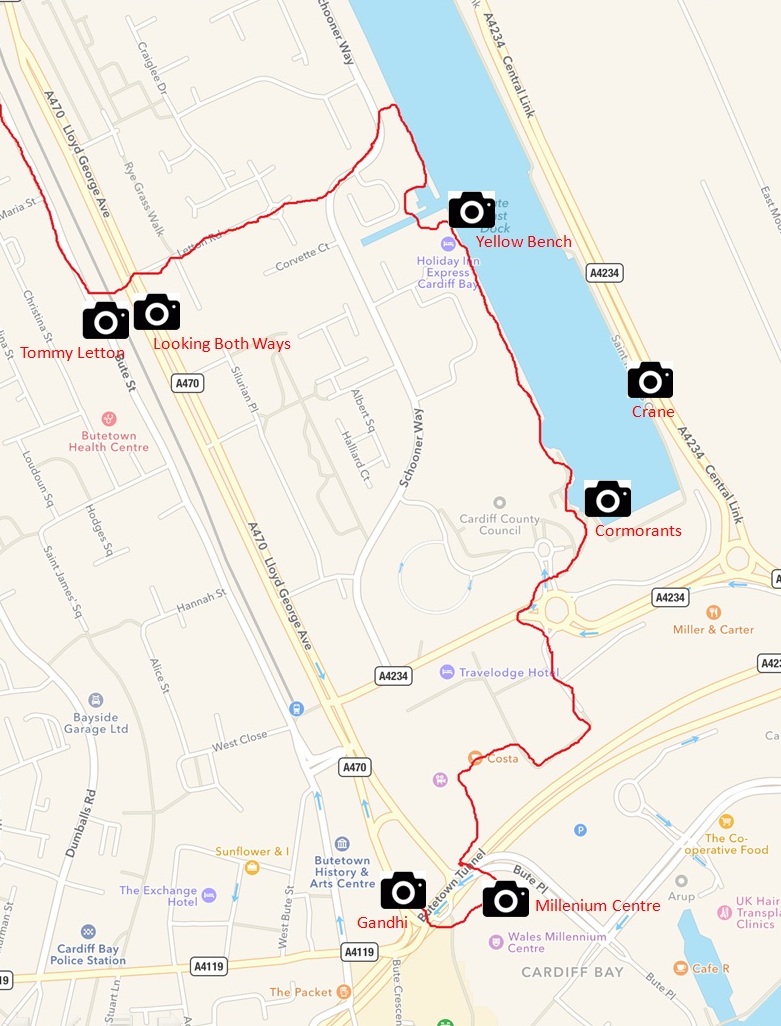
Its probably less than a mile from the centre of Cardiff to Cardiff Bay, particularly if you count the centre as being the Cardiff Central train station or John Lewis. There are quite a few different routes you can take though walking on the wide pavement alongside Lloyd George Avenue is probably the most pleasant.  I took in a bit of that route today but also deviated off to see some other interesting sights.  Here's what I saw.

First up was a blue plaque to Tommy Letton. Who was he?

Tiger Bay Cardiff Blue Plaque


Tommy 'the fish' Letton turns out to be a fishmonger who used to pull his cart through the streets of Tiger Bay in former years.  He's even got a road named after him.  This blue plaque is on the underpass that leads from Bute Street to Letton Street.

Letton Fish Cart
Tommy Letton and his cart in the 1960s. 

On the other side of the underpass I came out on Lloyd George Avenue, a wide boulevard that's not too busy and with a wide pavement and cycle path.  It make a good way to walk down to the Bay.

I came across Looking Both Ways, a sculpture by English sculptor David Kemp based in Cornwall.  It seems to have stood the test of time.

Lloyd George Avenue Cardiff
Looking Both Ways, in place since 2001 and still looking good.

David Kemp alongside one of his other works in 2010

It is possible to continue walking down Lloyd George Avenue from here towards Cardiff Bay but instead I wanted to take a look at Bute East Dock so headed east along Letton Road, over the old canal feeder, and down onto Schooner Way. After a bit of a scramble I managed to get down onto the block paved path that runs around the dock.

The East Bute Dock looking back up towards the city

Bute East Dock opened in 1859 and marked when Cardiff turned from an iron exporting town to a giant coal exporting city.


Andrew Rowe Bench
The Yellow Bench
The Yellow Bench, designed and built by Andrew Rowe in 1999, is outside the Holiday Inn Express. Andrew is a South Wales blacksmith based around Carmarthen.

Andrew Rowe who sculpted the Yellow Bench, making poppies in 2016 to be part of the new Cenotaph in Ypres, Belgium. 
Looking across Bute East Dock you can see a preserved dockside crane. It is a lot younger than the dock itself and a plaque describes how this 15 tonne electric crane has been moved around various dockside locations in Cardiff including the Queen Alexander dock.

Built in 1933 and decommissioned in 1983

Cormorants enjoying the sun in Bute Dock


I arrived at the southern end of Bute Dock but found that from there its rather a tortuous route through to Cardiff Bay. The path takes you up into the car park of Cardiff Council buildings when suddenly all footpaths seem to dry up. I ended up crossing Hemingway Road and found myself in the car park of the Red Dragon Centre. Failing to find a way around that I entered the centre itself then out the side entrance and over the road to the Millennium Centre.

I was about to critisise the architect of the Red Dragon Centre but thinking about it I wonder if it ever had an architect. It looks like the builders turned up, couldn't find the plans so built an ugly box,  thinking that they would return later to add the outside once the plans had been found. It's main entrance faces an ugly car park, not the lovely Millennium Centre. And whilst I'm at it I may as well moan about the walk between the Red Dragon Centre and the Millennium Centre. The way is blocked by curvy bollard type things. What's all that about?

Millennium Centre Cardiff Bay
Torchwood HQ in Cardiff Bay outside the Millennium Centre


Mahatma Gandhi sculpture


From here I headed over to take a look at the new Mahatma Gandhi sculpture that is outside Craft in the Bay. It was unveiled in October this year on the International Day of Non-Violence. The sculpture appears to have been paid for by fundraising by the Hindu Council of Wales. I rather like it I must say. I think its a welcome addition to the sculptures of the Bay area.


Mahatma Gandhi statue Cardiff Bay
The inscription reads "Non-violence is the greatest force at the disposal of mankind. It is mightier than the mightiest weapon of destruction devised by the ingenuity of man"

The unveiling took place on what would have been Gandhi’s birthday and was attended by the iconic statesman’s great-grandson, Satishkumar Dhupelia, who traveled from South Africa.

Cardiff to Cardiff Bay walking route

Route from Cardiff City Centre to Bay
A Winding Way to Cardiff Bay


Monday, 2 October 2017

Snowdogs of Wales

This autumn sees the appearance Cardiff of some 43 lovely Snowdog sculptures together with 57 Snowdog pups.  They are based on the novel and animated film Snowman and the Snowdog.

Snowdog Plentyn by Cardiff artist Vikki Cornish outside the Central Library


These art trails are all the rage and cities across Europe have been hosting various animal sculptures for some years now.  I think I saw my first ones, cows, in a Swiss city some fifteen years ago now.

The sculptures are made from what I guess is tough glass reinforced polyester.  Their limited display period cleverly ensures they are removed before they get weathered or too damaged.

Pop Pup by Bristol artist Damien Jeffery in Cardiff Central Square.


The Cardiff Snowdog trail is in conjunction with the children's charity Ty Hafan.  The trail serves the purpose of raising awareness of the charity and encourages donations.  Here's the link to the trail: Snowdogs in Wales

The Snowdogs are individually painted by various artists and at the end of their display period are auctioned off in aid of Ty Hafan.  The smaller pups have been painted by local organisations such as schools and guide groups.

The Pups in Central Library.


The trail makes the most of social media, encouraging visitors to post photos of themselves standing next to a Snowdog they like.

Like all works of art I would encourage people to stop and take a real look at them and admire the work that has gone into creating them.  They are certainly tactile in nature and I noticed many passers-by stop and give them a stroke.  People's first instinct these days seems to be to have a picture of themselves taken with one of the sculptures. That's not necessarily a criticism, more just an observation.

Personally, I also get enjoyment from coming home and researching the various artists, looking at their other work online and seeing what thy were trying to express in their Snowdog art.

McCoo by Steven Brown.  
If you have't seen any Steven Brown artwork then I recommend he is well worth a look.

And now time for a confession.  I'm a list man.  There's nothing I like more than working towards completing a list.  Will I get to see all 100 Snowdogs and their pups before they disapear?  The 99p App makes it easier to track progress.  I'll add and extra dimension to my challenge.  I will only use public transport in my quest.

Candy Stripes decorated by ceramic artist Lowri Davies
All 100 Snowdoogs and pups

And so with a couple of weeks to go till the Snowdogs were taken off display I made it.  All 100 Snowdogs and pups visited and only by the use of public transport.  I used the train to reach places like Barry Island and Penarth and the bus to go to Cardiff Airport and some of the parks in Cardiff.  I thoroughly enjoyed the experience, the artwork and the adventure.  Many thanks to all the artists.